
This guide explains how many stocks are typically needed for diversification, the problems with too many stocks, and how dividend investors might approach this differently.
If you’re asking:
“Do I own enough stocks, or am I risking too much by holding so few?”
Or
“Will adding another stock really make my portfolio safer, or am I just complicating things?”
Then you’re in the right place.
Key Takeaways
- 20 stocks are the ideal number to minimise risk.
- Managing 20+ stocks can be costly and time-consuming.
- Income investors often exceed 20 stocks to ensure frequent, stable payments.
- ETFs offer easy diversification.
- Only add a stock if it adds unique value.
Why Diversification Matters
To better understand diversification, consider the analogy of having all your eggs in one basket.
If you carry all your eggs in a single basket and accidentally drop it, you stand to lose all of your eggs.
Split the eggs between two baskets, and if you drop one basket, then you’ve only lost half instead.
Similarly, if you invest all your money into a single company and that company experiences a downturn, your investment may suffer.
However, by spreading your investments across different companies and different sectors, you’re effectively distributing your risk, just as you would if you carried multiple baskets for your eggs.
If one basket falls, you still have other baskets to rely on.
Therefore, you don’t want just one company or one stock. That would be a bit of a disaster if you dropped that basket. That means you want more than one company in your portfolio.
But this then begs the question: is it the case that more stocks are always better, or is there a point where adding more doesn’t really reduce risk anymore?
The Modern Portfolio Theory
According to Modern Portfolio Theory, there’s a point where adding more stocks doesn’t really reduce your market risk. That point is about 20.
If you look at the axes of this Portfolio Risk chart from Investopedia:
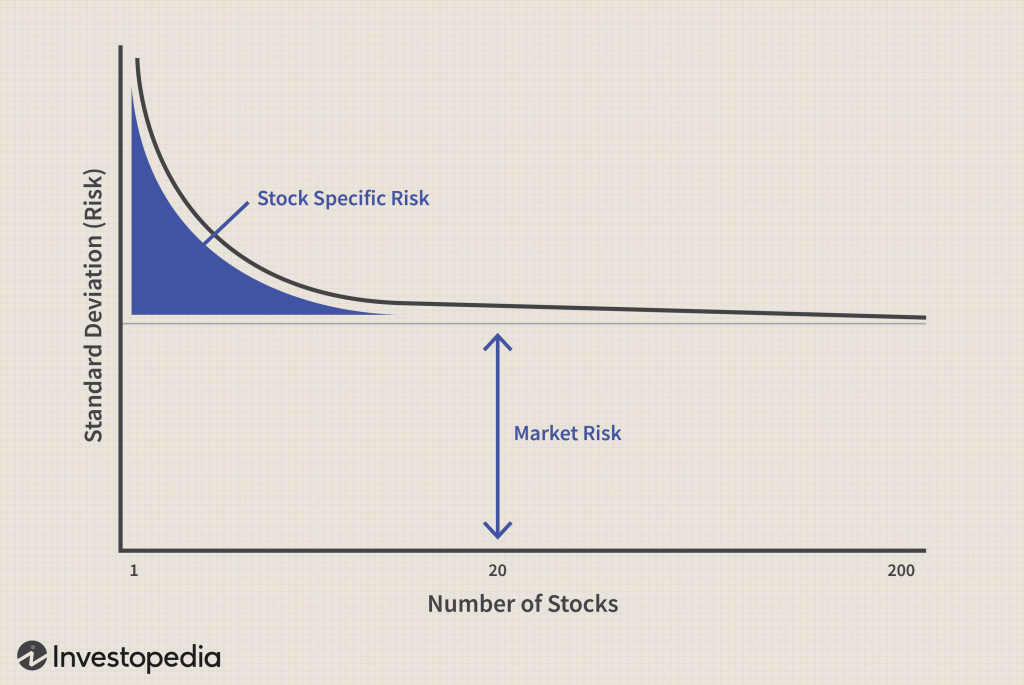
Image by Julie Bang © Investopedia 2020
:max_bytes(150000):strip_icc():format(webp)/TheDangersOfOver-DiversifyingYourPortfolio-1171d85499d6461ea916884a50c8c25d.png)
- The standard deviation (or risk of the portfolio) is on the Y-axis — the higher it goes, the more risk; the lower it goes, the less risk.
- On the X-axis is the number of stocks in your portfolio — so as it moves further away from the start, it’s a portfolio with more and more stocks.
When you start, you have one stock and the risk is the highest it’ll be.
Add another stock, and the risk jumps quite a fair bit down, and you become slightly more diversified. Add another, and it drops again.
But as this goes on, you eventually get to the point where the next stock you add makes so little difference to the risk of your portfolio that it doesn’t really help much.
Many people say that the point is around 20.
Looking at the graph, there’s a lot of risk that just can’t be diversified away.
This is the reason why a lot of people will tell you: “You need about 20–30 stocks, and not really more than that, in a portfolio.”
Problems With Having Too Many Stocks
Adding more stocks does bring problems, and here is why:
1. Cost
Building up a diversified portfolio can be a costly endeavour if the broker charges per trade.
If the broker charges £10 a trade and you follow this 20-stock advice, that’s a bill of £200 before you even get started.
Using a low-cost broker can reduce this burden.
2. Management
Managing a portfolio of 20 stocks is challenging due to the need for thorough analysis and the sheer volume of information.
Each stock requires examination of factors like financial performance, industry trends, and management quality.
This demands significant time and effort.
Furthermore, the abundance of stocks can cause information overload; keeping up with news, earnings reports, and analyst recommendations for all 20 stocks can be overwhelming.
This is also why it’s often appealing to invest in a broad-based market ETF, as it offers diversification with just one investment.
For example, VWRL is only one stock for you to manage, but in fact, it’s 3,672 stocks all wrapped into one.
Why Dividend Investors Are Different
Dividend investors are different because building a dividend portfolio requires considering the diversity of payments.
When you’re planning to live off dividends, retiring on dividends or paying for your minimum viable lifestyle, you want payments to come in regularly.
If your boss paid you once per year, it’d be much harder to manage than being paid monthly or bi-weekly.
Therefore, you want diversity of payment frequency and diversity of payment sources.
A common mistake among investors is going all-in on a single high-yield stock.
This works fine until it doesn’t — when that company cuts, your income is completely gone.
Managing Dividend Stocks Is Easier
Here’s the other big difference: managing dividend stocks is easier.
Let’s take National Grid in the UK — an energy infrastructure company.
It fits almost perfectly as a “natural” dividend payer.
Check the news and the earnings report, and to be honest, not much changes quarter to quarter. Its share price volatility is relatively low because not much impacts it.
Now, compare it to a stock like Palantir.
Entire YouTube channels are made about this company, with news and speculation happening almost daily.
Ask yourself: how many National Grids could you manage?
And how many Palantirs could you realistically manage?
The mental energy required to track dividend payers is typically much less than the mental energy required to track high-volatility growth stocks.
Conclusion
So, how many stocks should you own?
The answer is similar: “How long is a piece of string?”
It depends on:
- What kind of portfolio do you want to build
- The requirements of your goals
- Whether you’d rather keep things lean with an ETF or spread your risk across 20, 30, or even 50 dividend payers.
When adding your next stock, ask yourself:
Does it offer something my portfolio doesn’t already give me?
If not…
iIs it really worth adding?
FAQ
What is the exact number of stocks to own?
There’s no exact number, but according to Modern Portfolio Theory, the number is around 20. At this point, you have diversified away most of the specific risk associated with individual companies.
Why shouldn’t I just own 100 stocks?
Owning too many stocks can lead to information overload and potentially higher trading fees. It becomes very difficult to keep up with news, earnings reports, and analyst recommendations for that many companies.
Why do dividend investors own more than 20 stocks?
Dividend investors often ignore the 20-stock rule because they need “diversity of payments.” They often hold more stocks (sometimes 50+) to ensure they receive cash flow frequently, like monthly or bi-weekly.
Is managing dividend stocks easier than managing growth stocks?
Generally, yes. Dividend payers like National Grid are often stable companies where not much changes from quarter to quarter. High-growth stocks like Palantir often require much more attention due to high volatility and daily news cycles.
How can I diversify without buying 20 different stocks?
You can invest in a broad-based market ETF (Exchange Traded Fund). For example, buying VWRL gives you exposure to over 3,000 stocks with a single purchase, offering instant diversification.