
This guide explains what the W-8BEN form is, why it matters for UK investors holding U.S. stocks, and how ignoring it could cost you thousands in unnecessary tax over your investing journey.
If you’re asking:
“What is this W-8BEN notification on my investing app?”
or
“Do I need to fill out a W-8BEN form even if I’m not American?”
Then you’re in the right place!
Key Takeaways
- W-8BEN = Certificate of Foreign Status for U.S. tax purposes
- Without it: The U.S. withholds 30% tax on your dividends from American companies
- With it (UK investors): Tax reduced to 15% thanks to the UK-US tax treaty
- Impact: A 5% dividend yield becomes 4.25% (with form) vs 3.5% (without)
- Renewal: Must be renewed every 3 years or when circumstances change
- Most UK brokers (like Trading 212) handle this during account setup
What Is a W-8BEN Form?
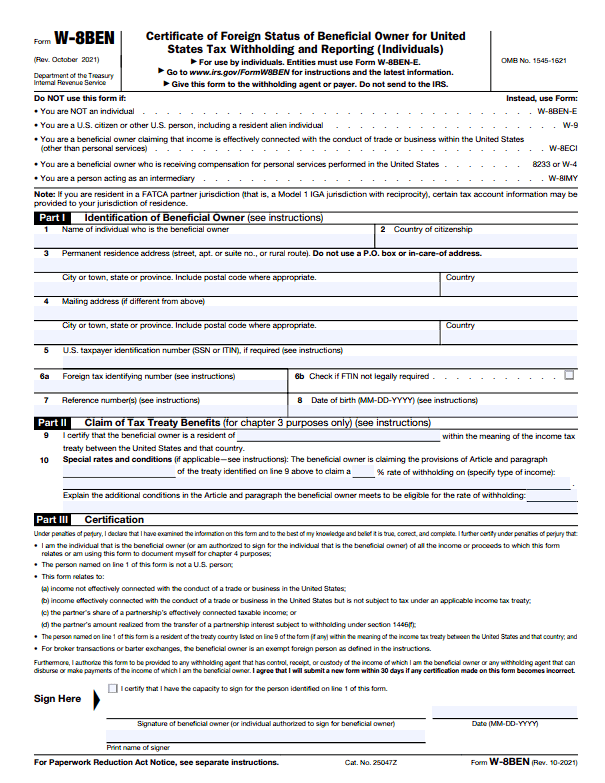
A W-8BEN Form, officially called the Certificate of Foreign Status of Beneficial Owner for United States Withholding and Reporting, is a U.S. tax document for non-U.S. investors.
When you see IRS tax forms like this, you might be thinking: “The IRS is an American thing, I’m not American, so I don’t need this.”
Actually, if you’re not American, that’s exactly why you do need it: to stop the U.S. from charging you too much tax on dividends from American companies.
The W-8BEN tells the U.S. government, “I’m not a U.S. resident,” and this declaration affects how much withholding tax you pay on income from U.S. sources, including dividends, interest, rent, or royalties.
Depending on your home country and any tax treaties in place, you might pay significantly less tax on that income. You may check the latest W-8BEN form here.
Why Is the W-8BEN Form So Important?
Because without W-8BEN, you can end up paying the maximum U.S. withholding tax rate on your dividends by default.
Here’s the simple version:
When certain income is paid from U.S. sources, especially dividends from U.S. companies, the U.S. has rules that allow the payer, usually your broker, to withhold tax before the money even reaches you.
And if you haven’t provided the right paperwork to prove your foreign status and claim any treaty benefits, the broker may have to withhold at the default top rate, which is often 30%.
That can make a big dent in your dividend income. We can demonstrate this with easy numbers:
You buy a U.S. stock paying a 5% dividend yield. If 30% is withheld, you don’t actually receive 5%. You receive 3.5% net.
Another way to see it is in real money:
Say your U.S. investments pay you $1,000 in dividends over a year. If the default 30% withholding applies, $300 is taken right away and you receive $700.
But if your correct rate is lower because of a tax treaty, that difference can be huge.
The UK-US Tax Treaty Advantage
Here’s the good news: because the UK has a tax treaty with the U.S., the withholding tax is reduced to a much more reasonable 15%.
That means instead of losing 30% of your dividends, you only lose 15%—effectively doubling your after-tax yield compared to not filing the form.
With a W-8BEN form (UK investors):
A 5% dividend yield × 85% (after 15% withholding) = 4.25% net yield
Without a W-8BEN:
A 5% dividend yield × 70% (after 30% withholding) = 3.5% net yield
So you’re keeping an extra 0.75 percentage points of yield, and over years of investing, that can easily add up to thousands of pounds in additional dividend income.
One important note: this treaty advantage depends on your residency and circumstances — but for most everyday UK investors buying U.S. shares, this is the key reason the W-8BEN matters.
Back to our examples of U.S. investments paying you $1,000 in dividends over a year. If the default 30% withholding applies, $300 is taken right away and you receive $700.
However, at the UK tax treaty rate, at 15%, you’d only lose $150 instead of $300 — and you’d keep an extra $150. So for every £100 of dividends, you might only see £70 — and that difference adds up year after year.
This is where the W-8BEN matters.
By completing the W-8BEN, you’re formally declaring:
- You’re not a U.S. person, and
- You may be eligible for a lower withholding rate under a tax treaty.
So instead of being treated like an “unknown” foreign investor who gets withheld at the maximum rate, your investment platform or broker can apply the correct rate for your situation.
And the bonus is that it also makes the admin cleaner: the broker has the documentation they need, the withholding is handled automatically, and you avoid the headache of trying to untangle over-withheld dividends later.
What if you’re not in the UK?
This is where it gets a bit more variable.
Different countries have different tax treaties with the U.S., and that means the “reduced rate” might be 15%, or might be 10%, 5%, or 0%.
In some cases, there may be no reduction.
I’m UK-based, so I’m not au fait with every country’s exact treaty rules, and I don’t want to guess and accidentally mislead you. Tax advice is serious business after all!
But the principle is the same wherever you live:
If you don’t have the W-8BEN in place, you can be pushed onto the default maximum withholding.
If you do have it in place, your broker can apply the correct rate for your country — including any treaty benefits you’re entitled to.
How to Fill in the W-8BEN Form Correctly
Completing the W-8BEN form is crucial for those holding U.S. stocks to ensure proper tax withholding and compliance.
The form has several key sections:
1. Personal information (name, address, country of residence, etc.)
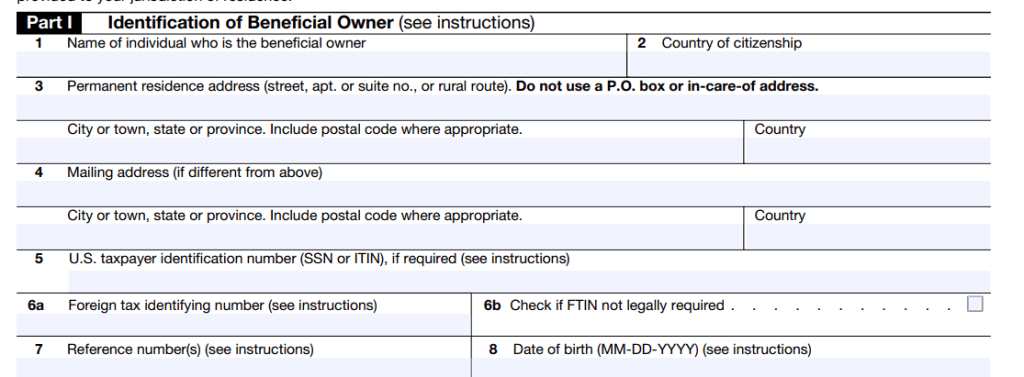
This is the “who are you?” section. You’ll normally enter:
- Your full legal name
- Your country of citizenship
- Your permanent residence address (your real home address, not a PO box)
- Your mailing address (only if it’s different)
- Your date of birth
For most people, that’s all Part I is.
2. Tax Identification Numbers
This is where people overthink it.
Depending on the broker, you may be asked for:
- A foreign tax identifying number (for the UK, that’s commonly your National Insurance number
- A U.S. taxpayer ID, like an ITIN (most everyday investors don’t have one)
If you’re not sure what your broker wants here, follow their guidance on-screen, but don’t invent anything.
If you genuinely don’t have a number they’re asking for, check the broker’s help page or support, because the correct answer is sometimes “leave blank” depending on your situation and platform.
3. Tax treaty benefits (where you claim reduced withholding under a treaty, e.g., UK-US)

This is the part that actually creates the benefit for most investors.
You’ll usually:
- Confirm your country of tax residence, and
- Confirm that you’re claiming the benefits of the tax treaty between your country and the U.S.
UK investors will often see the rate displayed as 15% on dividends once this is set up correctly.
If you’re in another country, the broker may show you the treaty rate, or it may just ask you to confirm you’re treaty eligible.
4. Certification and Signature
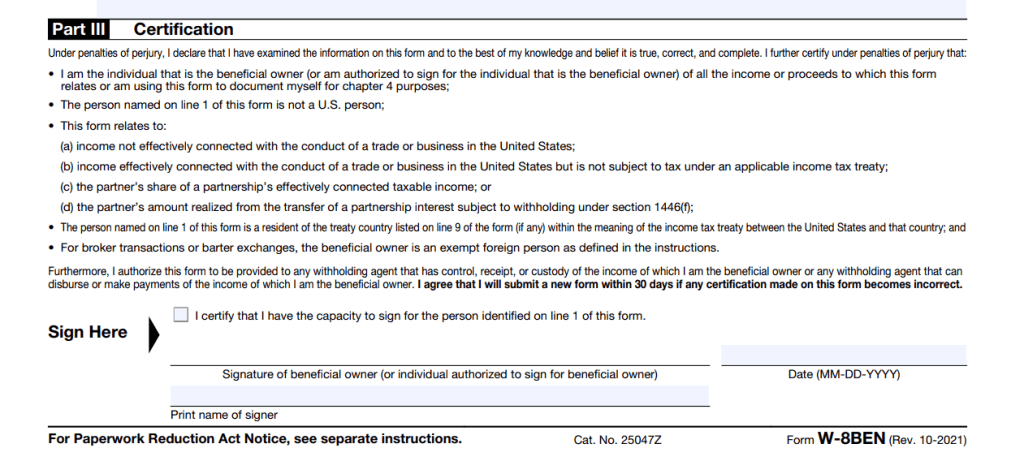
Finally, you sign and date to confirm everything is true.
And that’s it.
Once submitted, your broker keeps it on file and applies the appropriate withholding rate to future dividend payments.
Three Quick Mistakes I See Time and Time Again
- Using the wrong address
Use your real permanent residence address; it matters for residency and treaty claims. Not sure how people mess this one up so much, but it does happen. - Forgetting it expires
W-8BEN isn’t permanent. Brokers typically prompt you to renew it periodically, and if it lapses, they may revert to the default withholding rate. - Assuming an ISA fixes it
Probably the biggest one here. If you’re in the UK, an ISA protects you from UK tax, but it doesn’t automatically stop U.S. withholding, because that’s taken before the dividend reaches your account. So if you hold U.S. shares in an ISA, having a W-8BEN on file can still matter.
How UK Brokers Handle the W-8BEN
Most UK brokers simplify this process significantly:
Trading 212 and similar platforms will ask you to sign and submit a W-8BEN form during account creation. This step is mandatory and cannot be skipped. The process typically involves ticking boxes and confirming your details, making it time-efficient for investors.
Some brokers may require you to submit a W-8BEN form separately after creating an account. If your broker requires a manual submission, you can obtain the official PDF from the IRS website or request it from your broker’s support team.
With most modern brokers, the form is largely autocompleted based on the information you provided during signup. You simply need to verify that the details are correct and submit.
Is the W-8BEN Form Permanent?
No.
The W-8BEN form needs to be renewed every 3 years from the day it was signed—or sooner if there are any substantial changes to your income or tax status.
Don’t forget to update it when it expires. Most brokers will send you a reminder notification when your W-8BEN is approaching expiry, but it’s worth making a note in your calendar to check periodically.
If your circumstances change—for example, if you move to a different country—you should update your W-8BEN form immediately, as this may affect your tax treaty benefits.
Final Thoughts
Many people find tax forms intimidating, but with a bit of patience and attention to detail, you can complete the W-8BEN form and protect your dividend income.
Nowadays, most brokers will help you complete the form during account setup. You can verify that the details are correct and move on with your day.
It’s a small step that can have significant benefits in the long run, potentially saving you thousands in unnecessary withholding tax over your investing journey.
Remember: without this form, you’re voluntarily giving up 15% of your U.S. dividend income that you’re entitled to keep under the UK-US tax treaty. That’s money that could be reinvested to compound your returns over time.
FAQ
Do I need a W-8BEN if I only invest in UK companies?
No. The W-8BEN is only required if you hold U.S. stocks or ETFs that contain U.S. stocks. If you exclusively invest in UK or other non-U.S. companies, you don’t need this form.
What happens if I forget to renew my W-8BEN after 3 years?
Your broker will automatically apply the default 30% withholding tax rate on your U.S. dividends until you submit an updated form. You won’t be able to reclaim the excess tax withheld during this period, so it’s important to renew on time.
Can I reclaim tax if I didn’t file a W-8BEN initially?
It’s extremely difficult to reclaim excess withholding tax after the fact. The IRS process for non-residents is complex and time-consuming. It’s far easier to ensure your W-8BEN is filed correctly from the start.
Does the W-8BEN affect my UK tax obligations?
No. The W-8BEN only determines how much tax the U.S. will withhold at source. You still need to report your dividend income on your UK Self Assessment tax return if applicable, though you may be able to claim foreign tax credit relief for the U.S. tax already paid.
What if I hold U.S. stocks in an ISA?
You still need a W-8BEN form. While ISAs shelter you from UK tax on dividends, they don’t protect you from U.S. withholding tax. The 15% (or 30% without the form) is still deducted at source before the dividend reaches your ISA.